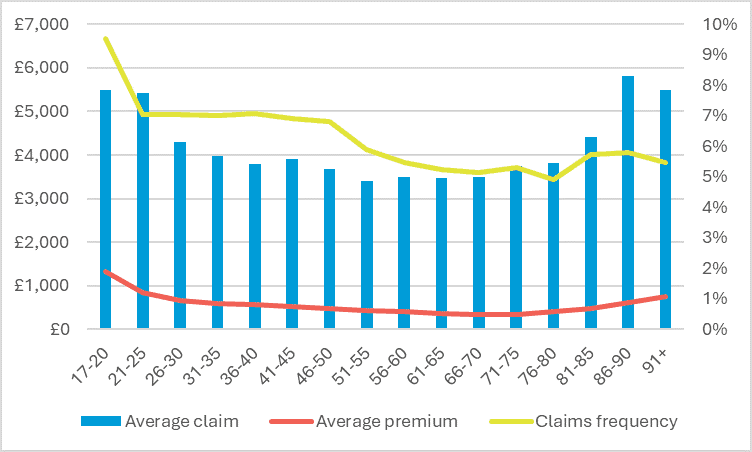
This chart shows the percentage of customers claiming per policy, the average cost of a claim and the average premium for different age groups for private motor insurance in 2023.
- For all age bands, there is a clear relationship between premiums paid and the cost of claims. This pushes premiums up for younger and older drivers.
- For drivers between the ages of 31 and 75, premiums fall significantly.
- Of this group, drivers aged between 66 and 70 are the best off, paying less than the average price paid by 17-20 year olds.
Why is car insurance so expensive for young drivers?
The main reason car insurance for young drivers is so expensive is because statistics show that young drivers are far more likely to be involved in accidents than drivers aged 25 and older. Drivers aged 17-24 only make up 7 per cent of UK licence holders and drive fewer miles than the average but are involved in 24 per cent of all fatal collisions.
Young drivers are more at risk and more likely to make a claim, which is why car insurance tends to be more expensive than for older drivers.
What is the ABI doing to reduce the cost of car insurance?
We have long campaigned for reforms to help stem rising motor insurance premiums caused by factors such as the current way compensation pay-outs are calculated and a resurgence in whiplash-style claims.
However, insurers cannot solve this problem alone.
More than any other sector of the driving population, young drivers need the Government to act to help them manage their motor insurance bills and we continue to make the case for introducing reforms to personal injury compensation, freezing the rate of Insurance Premium Tax and implementing Graduated Driver Licencing (GDL) to protect both young drivers and those already on the road.

Understand the rising cost of motor insurance
Stay informed about the factors driving recent increases in insurance premiums. Our comprehensive FAQ addresses key issues such as the rise in motor insurance costs, the impact of regulatory reforms, and the various factors insurers consider when assessing risk.
Danger and young drivers
Young drivers remain a major danger on the road, to themselves, their passengers and other road users. Young drivers are grossly overrepresented in the official accident figures and each statistic represents a tragic waste of life that could be prevented.
We have long campaigned for safer roads. We have consistently argued that unless radical reforms are made, the poor safety record of young drivers will continue. If the number of crashes involving young drivers decreases, the financial risk they pose to an insurer will decrease and insurance premiums for young drivers will follow.
Crashes involving young drivers are generally the result of one or more of the following:
- Driving at night
- Excessive speed, sudden braking and loss of control
- Adverse driving conditions
- Passengers
- Young drivers carrying two young passengers are twice as likely to be killed as those driving alone; and they are four times more likely to die if they have three young passengers
- Attitude
- Young drivers are far more likely to be involved in a crash due to being careless, reckless or in a hurry than drivers aged over 25
What can be done to improve road safety for young drivers?
Graduated driver licensing
Graduated driver licensing (GDL) is designed to delay full licence issue, allowing beginners to obtain their initial driving experience under lower risk conditions. It is divided into three stages: a minimum supervised learning period, an intermediate licence period that places restrictions on the newly qualified driver, and the acquisition of a full, unrestricted, driving licence available after completion of the first two stages.
The current UK licensing system allows a young person to drive unaccompanied and with no restrictions as soon as they pass their practical driving test unlike with a motorbike where they have graduated licensing. It is therefore unsurprising that many young people try to pass it in as little time as possible, many taking just a few months to learn the skills required to pass the test. The result is that inadequate emphasis is placed on the benefits of gaining road experience and, subsequently, young drivers can have little experience of driving in different road and traffic conditions. It is unsurprising that these drivers with the least experience subsequently go on to have the highest crash rates when fully licensed.
We propose the following measures to improve the situation in the United Kingdom
- A minimum 12 month learning period before the driving test can be taken, enabling drivers to undertake supervised practice without an incentive to rush to take the practical test.
- The lowering of the age at which young people can start learning to drive to 16 ½ years.
- A ban on intensive driving courses.
- Introducing graduated driver licensing for drivers under the age of 25. During the intermediate phase, restrictions would be placed on the number of passengers a young person can carry and the time of day they can drive.
- Restricting the number of passengers young drivers are able to carry for a period of 6 months.
- A night time driving restriction between 2300 – 0400 during the first 6 months of driving.
- A lowering of the blood alcohol limit to 20mg/100ml during the intermediate phase